


Japanese Stiltgrass - ID & Management

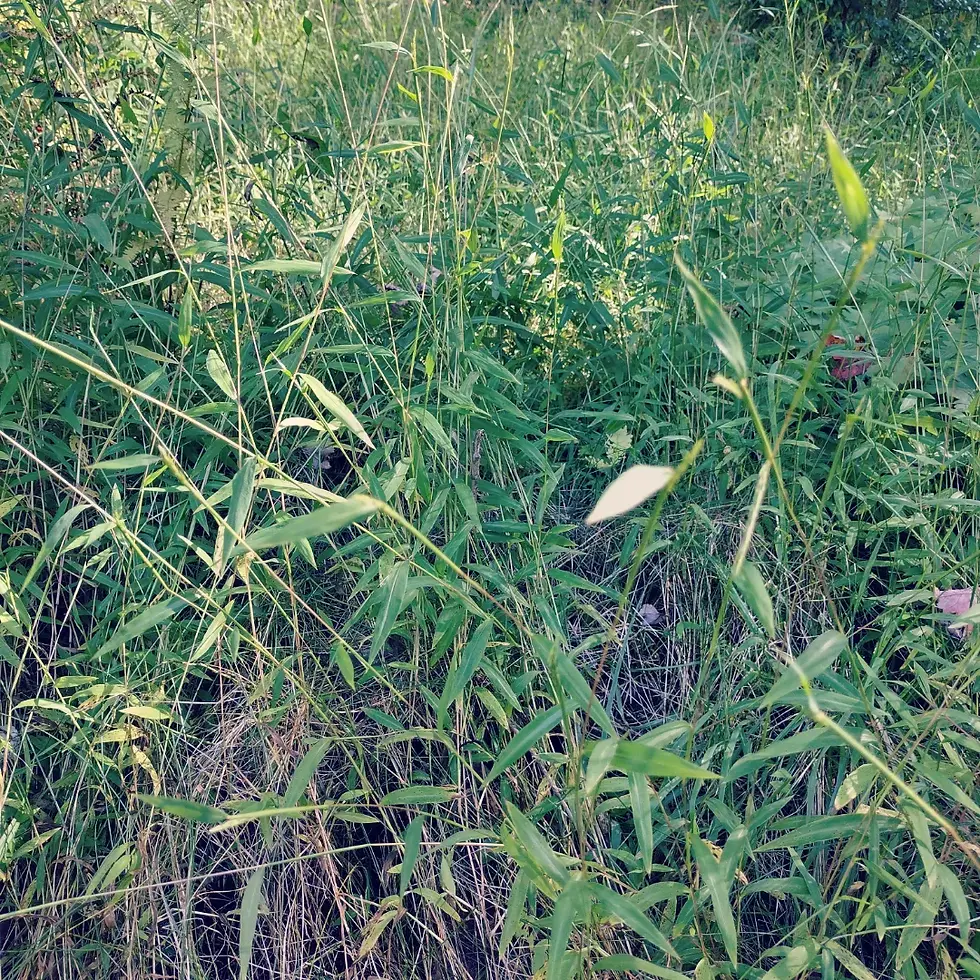
If you’ve walked your woods, field edge, or shady lawn lately and noticed a sea of bright green grass creeping in, it could be Japanese stiltgrass (Microstegium vimineum). It’s important to identify it and manage it at the right time of year. JUMP TO to Identifying Stiltgrass
There’s many properties that I have worked on where it has overtaken areas that have been

disturbed by construction and I’ve also seen this completely overtake the entire forest floor at another property.
Stiltgrass was first documented in the U.S. in 1919, likely arriving as packing material from Asia (EDDMapS; InvasiveSpeciesInfo.gov). Today it’s considered one of the most damaging invasive plants in the eastern United States (Alabama Cooperative Extension System). The good news, it is manageable.
“Over 83% of land in the United States is privately owned.” Douglas Tallamy, entomologist. As a landowner, that means the woods behind your house, the ditch along your driveway and the edge of your lawn all matter.
When stiltgrass takes over, it crowds out the native plants that support insects. What does this mean exactly? Crowding out doesn’t just mean it takes over the flowers we want. The real loss is the host plants insects rely on for food and shelter. When those disappear, insects disappear. And when insects disappear, birds, fish, and small mammals lose a primary food source. It’s all connected.
When it comes to our yards, many of these tasks can feel daunting and here’s what I like to say in those moments. Focusing on how to make changes for an environmental impact seems too big for us to manage, but we can make a difference on a large scale collectively. We manage at a micro-level, our yards and land, to make a difference.
Identifying Stiltgrass
Early detection and rapid response is key to controlling this grass in your yard. The simplest description and the quickest way to identify stiltgrass: It looks like small, young bamboo. Yes, it is not bamboo and yes it is very different but I think this is an easy way to describe it without you needing to remember too much more. Here’s the more specific characteristics for identifying this grass:
Bright green smooth leaves, about 1–3 inches long
A faint silvery stripe running down the center of the leaf
A delicate, almost floppy stem - young stems may be reddish. After plants die back in late fall, dead, straw-colored stems persist through winter.
Very shallow roots (it pulls easily)
Flowers on 1- to 3-branched spikes formed at the top of each stem in late summer/early fall. Inflorescences can either require pollination or self-pollinate.
Three Ways I Manage Stiltgrass (Without Chemicals)
To put it simply, the good news is that this is manageable. Pull late. Don’t let it seed. Re-seed immediately.
1. Hand Pulling - Best for small patches. It pulls easily, especially after rain, but the roots are so shallow it pulls easily at any time.
2. Mowing/String Trimming - Good for larger areas. Mow it low and repeat as needed before seed forms.
3. Tilling - Useful in heavily infested open areas — but only if you’re ready to reseed.
4. Cover with Mulch, lots of it - The New York State Office of Parks, Recreation, and Historic Preservation has developed some experimental control techniques. Park biologists have proven that covering stiltgrass with 4-6 inches of mulch (chips, leaf litter) will prevent stiltgrass from emerging (OPRHP Minnewaska State Park Preserve Experiment, 2010, 2011, and Connequot State Park Preserve, 2011). They found that seeding directly into the decomposing layer will reduce future Japanese stiltgrass invasions. This treatment is suitable for treating trailside infestations and easily-accessible, small- and mid-sized patches.
When to pull (and my exceptions)
You should not pull it early. It’s tempting. You see it in June and want it gone but if you pull before July, the seed bank in the soil (from last year’s plants) can germinate and still go to seed later in the season creating more work for yourself.
Late summer, after July and before you see seeds forming in early fall, is the best time to pull. Ideally, that’s when I schedule removals. The exception to the rule is that when I’m planting a new garden and need the space for new plants I will pull grass at a less than ideal time. I also always put down mulch. If someone from the Project Meadow crew is maintaining a garden’s weeds consistently, this is an exception and we will pull earlier than we should.
How to handle after you pull:
Leave it to dry out and decompose, if there are no seeds.
If there are seeds, bag it and put it in the trash. Do not compost it!
If you have a safe burn pile established, this would also be a great solution as well either with or without seeds. Because I move between properties, I usually bag it to avoid spreading seeds accidentally.
If you pull and walk away, just be prepared for it to grow back. Bare soil is an invitation for seeds in the soil to germinate. The first stage of restoration is seeding annual ryegrass immediately after removal. This is also important if you’re having some sort of construction on your property that disturbs the soil. Annual ryegrass establishes quickly and competes with stiltgrass seedlings. Long-term, plan to incorporate native plants, this strengthens the space and rebuilds habitat.

Comments